
What is Climate Governance?
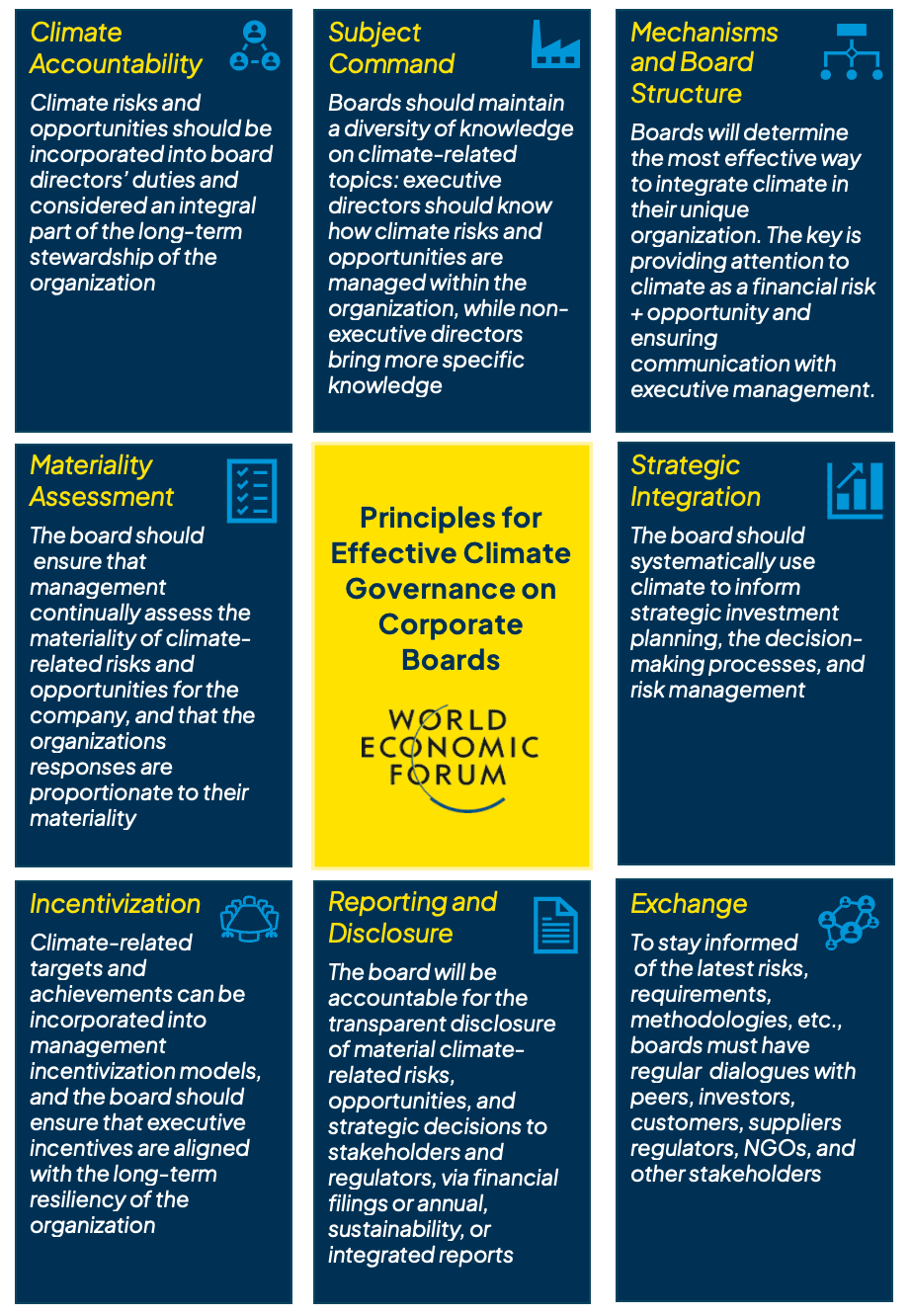
Climate governance focuses on integrating climate considerations into corporate strategies, so that organizations are well equipped to recognize climate related risks and opportunities and act on them. Boards, being accountable for the long-term stewardship of their companies, are responsible for setting up suitable governance mechanisms that include appropriate climate consideration across their organizations, in order to facilitate long-term resiliency.
What is the difference between climate governance and ESG?
Climate governance, via board action, may put into place certain mechanisms, resiliency measures, and strategic priorities considering the future impacts of climate change on a company.
As a result, climate governance may contribute to a company’s ESG strategy, however, ESG differs in its focus on the impact of the company, whereas climate governance focuses on putting into place the mechanisms and processes involved in the climate stewardship of the organization.
Where does governance fit into climate-related legislation?
Governance is a key component of managing climate risks and opportunities. Having climate governance structures in place create an efficient and resilient foundation, wherein companies can make climate-informed strategic decisions, manage climate-related risks, ensure communication across the business, and track climate targets.
Why should your business act, even if it is voluntary?
Today, investors take into account companies’ efforts to manage climate-related risks and opportunities, given that climate change will inevitably impact investment returns. Therefore, being proactive on climate governance-related topics makes your company more competitive and leaves it open to a wider range of financing opportunities.
Do SMEs need to be involved in the transition?
Given that SMEs represent 90% of all businesses globally, they play a large role in the path towards achieving climate targets. SMEs are exposed to the wide range of risks that accompany climate change, so, taking action on climate governance issues can also help reduce risk exposure. Although SMEs may not be regulatory obliged, they run the risk of falling behind due to finance and their place in the value chain if they do not take action.
What is the board’s role?
The traditional key roles of boards to drive operational performance, ensure regulatory requirements are met, and support the long-term viability of the organization, all have direct links to climate change. As a result, at the board level, it is necessary to build knowledge of the potential impacts of climate on the business and to create a strategic business case for climate action, while planning for future legislative and environmental change.
Regulatory Landscape: What’s Ahead?
Even if your business is not yet subject to climate compliance, there is a trickle down impact from financial institutions and major players in the supply chain that are already subjected to strict regulation. Your company can lose business and access to financing if it does not adapt.
Key Regulatory Frameworks Ongoing and in Discussion
What is the CSRD – Corporate Sustainability Reporting Directive?
The CSRD is a directive adopted by the EU that will increase reporting requirements for qualifying companies, in order to expand sustainability information for users. It already applies to companies under the NFRD and in 2026 it will apply to listed SMEs and more large companies.
What is the EU Taxonomy?
The EU Taxonomy classifies environmentally sustainable economic activities for investors and companies to make informed decisions based on the sustainability of an investment or business activity. It will apply to listed SMEs beginning in FY 2026.
What is the EU’s Nature Restoration Regulation?
This EU regulation seeks to protect and restore Europe’s natural environments, via binding targets for restoring and rehabilitating ecosystems, across all EU countries.
What is CBAM – Carbon Border Adjustment Mechanism?
CBAM is the EU’s tool for putting a fair price on the carbon emitted in the production of products entering the EU, to encourage lower emissions in industrial production in non-EU countries and ensure equivalent carbon prices for domestic and imported goods. CBAM will apply from 2026 in the following sectors: cement, iron and steel, aluminum, fertilizers, electricity and hydrogen.
