
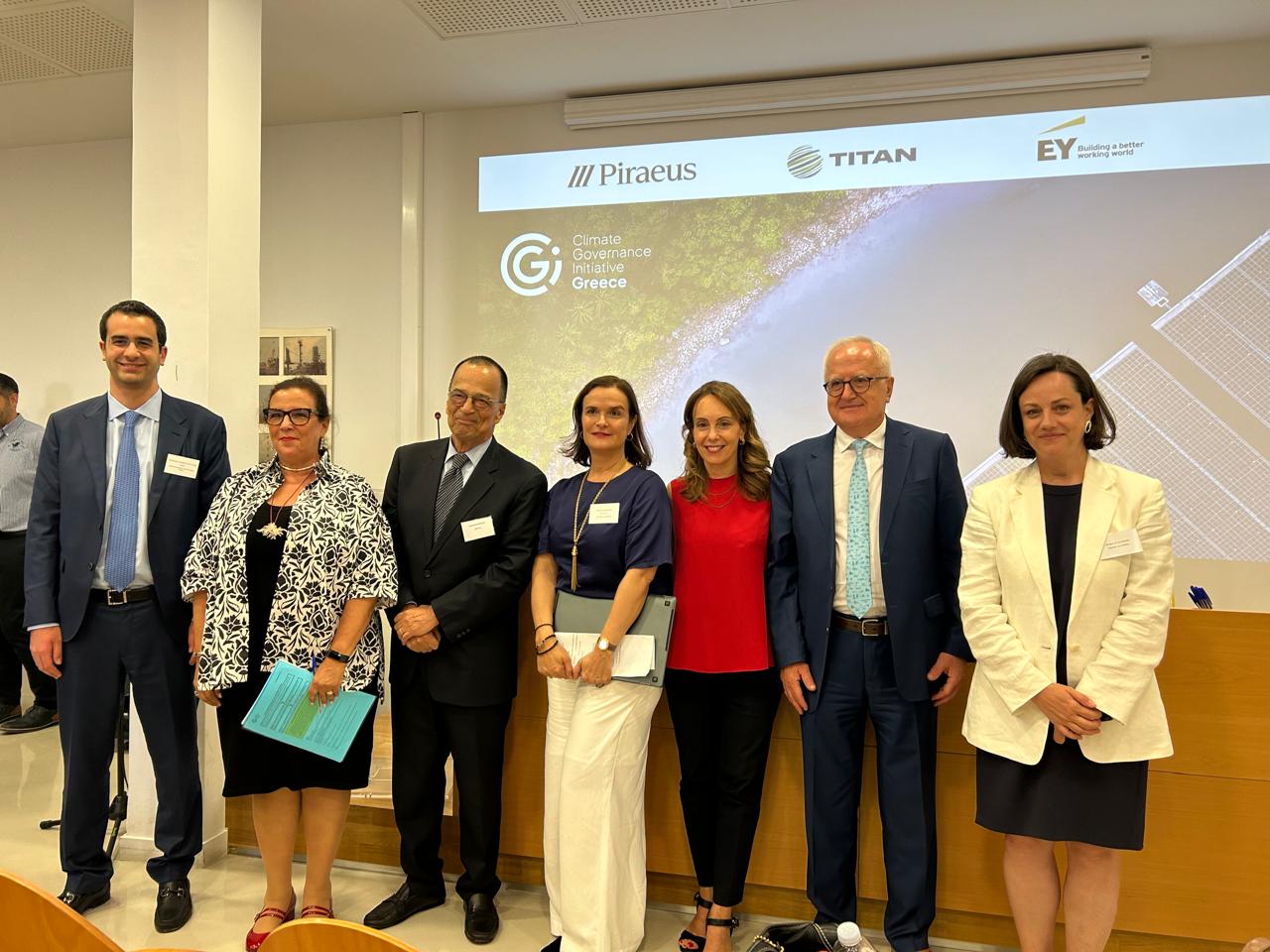
The Climate Governance Initiative (CGI) Greece hosted the event “Model Climate Governance Outreach Program” on 2 July 2024, in collaboration with Piraeus, TITAN, and EY Greece. The event focused on steps for collective climate governance action across the entire Greek ecosystem and the opportunities that accompany it.
The program featured distinguished speakers from a range of organizations, sharing their perspectives on the challenges and opportunities connected to climate governance, as it relates to financing, competitiveness, disclosure, and innovation. Below we share an overview of the event:
Key Takeaways
- Moving forward on climate action presents an opportunity to drive value, via the creation of new methods, products, and services to meet clients’ changing demands.
- Communication across the organization is essential to ensuring implementation of and sustained action on climate initatives.
- Banks face challenges in transforming their businesses, transitioning their portfolios and addressing relevant reporting and disclosure requirements around sustainable finance. Proper governance arrangements are key to successful implementation and operationalization of sustainable finance frameworks.
- Collective action is key to addressing climate change, both within an organization, by integrating ESG responsibilities across all departments and the board, and across the entire supply chain.
Why Climate Governance Matters and How Can Climate Governance Initiative Greece Help
George Handjinicolaou (Chairman of the Board of Directors of Piraeus) opened the event, reiterating that climate is an essential consideration across sectors that cannot be ignored. Marina Niforos (Climate Governance Initiative Greece Founder and President) emphasized that we cannot reach climate goals or maintain competitiveness with the idea that climate action is only for large, listed companies, instead climate action is necessary across the entire Greek ecosystem. She also discussed that beyond the issues of regulatory compliance and risk management, sound climate governance can represent significant financial and business opportunities, and Climate Governance Initiative Greece can guide companies on starting points and best practices.
The State of the Greek Ecosystem and Next Steps for Climate Action
Kiara Konti (Partner at EY Greece) presented an overview of the state of the Greek market on climate change issues, outlining that top areas for integrating sustainability initiatives include supply chain optimization, creating a technology roadmap, and innovating products and services. Importantly, board connectivity will play a significant role not only in reporting but also in implementing sustainability-related actions. Orestis Chontoulidis (Partner at EY Greece) detailed the requirements around the Green Asset Ratio (GAR) and its inherent limitations that may incentivize Banks to implement broader sustainable finance frameworks (covering SMEs as well), to better reflect the sustainable portion of their balance sheets – noting that proper governance and Board-level involvement will be key to successfully tackling the challenges of this transformation.
Expanding on this to address how companies can begin taking action, Stathis Potamitis (Board Member of CGI Greece) exemplified methodologies for integrating climate action, supported by the local and global content of the Climate Governance Initiative network. This included a diagnostic tool and roadmap that organizations can use to familiarize themselves with key first steps, implement the necessary mechanisms, and ensure future action.
Experiences of Greek Companies
Bringing the discussion to the company level, the panel hosted by Natalia Nicolaidis (Board Member of CGI Greece) focused on the innovative steps taken by Piraeus, Matrix Pack, and TITAN Cement Group to find business opportunities in climate action via new products and offerings to clients and customers. Solomon Berahas (Member of the Board of Directors of Piraeus) shared that climate change presents an opportunity for banks to drive innovation to help fund the green transition, noting the necessity for the entire ecosystem, from small business to banks, to incorporate ESG via the categories of climate and environment, CSR, and governance. Lyberis Polychronopoulos (President of the Board of Directors of Matrix Pack) detailed Matrix Pack’s innovative actions to provide sustainable packaging products to meet a growing preference for sustainable solutions, while simultaneously driving growth. He stressed that technology and communication across the organization are key factors of success as it relates to adapting to climate change. Further supporting this, Alexandros Katsiamboulas (Group Environment, Social & Governance (ESG) Performance Director at TITAN Cement Group) discussed the material opportunities that have developed from TITANs extensive work into providing low-emissions products, both via the business opportunities and the ability of these products to reduce the organization’s emissions intensity.
Providing the disclosure perspective Ivor Kadragic (Head of Strategic Accounts CDP) shed light on the importance of disclosure and the exponential increase being seen globally. He noted the high frequency of investors requesting disclosure from companies in their portfolios, including a growing number of Greek companies requested to disclose.
Conclusions and Next Steps
In conclusion, Maria Semedalas (Member of the Board of Directors of Piraeus) emphasized the opportunities that accompany climate action, with banks providing products and markets for purposeful investment, and companies creating new products to fulfill what clients and customers will demand. Leonidas Canellopoulos (Chief Sustainability and Innovation Officer at TITAN Cement Group) also reiterated the importance of innovation and approaching climate as an opportunity, as each new sustainable product can attract customers, better financing terms, and growth in new markets. He stressed the importance of collective action, noting that we should strive to have the entire board responsible for ESG issues, while incentivizing the entire organization to drive action.
Going forward CGI Greece will collaborate with the input from the Greek ecosystem to inform our future offerings, including a prototype program, our interactive website with member’s collaboration area, case studies, and collaboration with other CGI chapters for joint action. To share your opinion and help tailor the CGI Greece offerings to your climate governance needs, fill out the survey here: https://forms.office.com/e/1TPrhQFegs
