
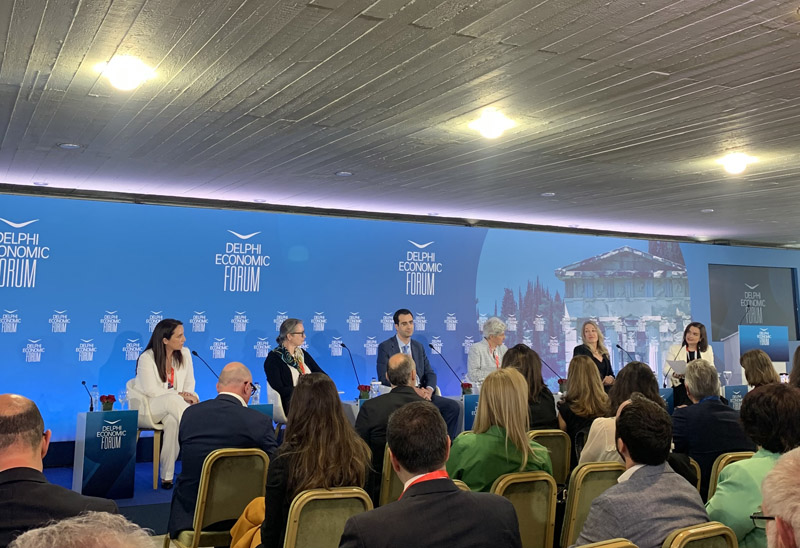
On April 11th 2024, Climate Governance Initiative Greece hosted a panel discussion in the context of the Delphi Economic Forum IX, entitled Navigating Climate Governance: A Public-Private perspective. The panel brought together speakers from corporate, multilateral, governmental, and institutional investor backgrounds to discuss building effective alignment between public policy and private capital to bridge the investment gap for climate action.
The panel was moderated by Marina Niforos, Founder and President of CGI Greece, with distinguished speakers: Ekaterina (Katya) Gratcheva (Climate Advisor, International Monetary Fund), Sylvie Goulard (former Deputy Governor of the Bank of France, MEP, and Co-Chair of the International Advisory Panel on Biodiversity Credits), Maya Hennerkes (Director of Climate Strategy and Delivery, EBRD), Leonidas Canellopoulos (Chief Sustainability Officer and Board Member, TITAN Cement Group), Konstantina Galli (Tax Services Partner, EY Greece). The discussion deliberated how to promote better collaboration between public authorities and private actors to secure necessary investments for green transition and for meeting climate action commitments, in addition to optimal policy measures that can facilitate further green investments at scale.
Key Takeaways
- Climate change mitigation and adaptation is a global issue, and therefore it requires a global approach in policymaking, not just a European one: Climate needs a global focus, particularly considering the trajectory of emerging markets with contradictory pressures between economic development and climate change management.
- Sustainability requires significant funding: The investment gap for achieving our climate action commitments require massive increase in investments, with the needs reaching 12$ trillion p.a. in emerging markets alone, with 80-90% of the investment expected to come from the private sector. Without a stable and transparent policy environment and direct measures to crowd in green investments, targets will not be achievable.
- Governance is the backbone of achieving climate goals – People are the driving force of this massive re-engineering towards green business models and consumption. When we are looking at companies, boards, as custodians of the company strategy, need to be at the driving seat of climate action mobilization and monitoring performance, to ensure transition planning, emissions tracking, and better ESG policies follow.
Views on climate finance from Greece, to Europe, to the Global Context
From a global multilateral perspective, Ekaterina (Katya) Gratcheva (International Monetary Fund) emphasized the need to move beyond a Euro-Centric perspective in designing climate solutions, given the global interconnectivity of supply chains. Providing further insight into emerging markets, Mrs. Gratcheva noted that emerging market countries are expected to account for 2/3 of emissions going forward; this will require significant investment in aligning energy systems, which is not happening currently. The stock of capital in the private sector is not flowing in the sectors we need to have an impact on emissions.
“While the stock of capital in the private sector is hundreds of trillions of dollars, it is not flowing to the sectors that are required in order to have significant impact on emissions. This is where public and private governance will need to come into closer collaboration.”
– Katya Gratcheva, IMF
At the regional and institutional investor level, Maya Hennerkes pointed out the EBRD commitment to provide not only capital, but also technical assistance for preparedness and awareness raising, with 50% of EBRD investments going to green financing. This holistic strategy is important given the “differing levels of understanding and readiness for dealing with climate risks, sustainability risks, social risks, and the more complicated area of nature, especially in SME sector.” She also stressed the critical importance of integrating climate considerations as part of sound corporate governance and their collaboration with the network of Climate Governance Initiative to promote this objective.
“When companies start looking at their climate corporate governance, they start thinking much more strategically about it, and very often this translates into transition planning. We see that they start thinking about their own governance…We then see the emergence of better ESG policies and fossil fuel policies, companies measuring their emissions, and setting targets for them. Governance is the backbone of all of this.”
– Maya Hennerkes (EBRD)
Speaking to the European experience and the extended climate mandate beyond emissions, Sylvie Goulard (IAPB, f. MEP) discussed goals of creating new financial instruments to funnel investments from the private sector to restoration. Additionally, she stressed staying focused on the larger picture to mobilize action and not waiting to have perfect data to act. “We need to keep the rules simple, but we also need to take into account the people, whether on the board level or in the companies. Data is not enough, particularly when the transition can be difficult and can meet significant resistance.”
“We should not talk of climate only…we should look at biodiversity as well. It is not that someone is adding nature [and biodiversity] to climate…Scientists consider these one topic. And this singular focus is how can we make sure that our production, our mobility, our human activity, is not going to harm the planet.”
– Sylvie Goulard (IAPB, f. MEP)
Brining the focus to the Greek policy framework, Konstantina Galli (EY Greece) noted that despite continuing economic challenges, greening of public policies are headed in a positive direction, though it remains an evolving process. She analyzed the potential of tax policy in providing both positive and negative incentives for companies to make their operations more climate-friendly, but also stressed the need for vigilance of collateral consequences of certain measures: for example, a tax on fossil fuels can be a deterrent for companies and a significant contribution to public revenue, but we should be mindful that as people shift away from using fossil fuels, public revenue will decrease drastically. These conditions necessitate regulatory macro-planning to mitigate economic impacts.
“Tax policy can be a powerful tool for governments and companies alike. We need to set priorities and take into account the broader impact of green tax policies on companies and the economy at large”
– Konstantina Galli, EY Greece
From the corporate perspective, Leonidas Canellopoulos (TITAN Cement Group) noted their strong commitment in moving the ledger on decarbonization for their company and their value chain, but that much more needs to be done. He addressed regulatory or carbon pricing uncertainties that create a challenging investment landscape for companies to develop green solutions. Shedding light on the situation for corporations in Greece, Mr. Canellopoulos also shared that the Greek market has a lack of infrastructure for storage of carbon capture and insufficient demand for green products, noting that a green premium would be monumental in encouraging investments. He also noted the deficit in “green skills” and talent, as people are the ones making the difference.
“The costs associated with carbon capture are immense…we don’t have the regulatory mature that is required, and we don’t have a credible signal in terms of the carbon price in the future. To make these investments, you need to be able to predict what’s going to happen in terms of the price.”
– Leonidas Canellopoulos, TITAN Cement Group
To view the full recording of the panel on our YouTube, follow the link here.
